Tanot Mata Temple: The Temple That Survived War
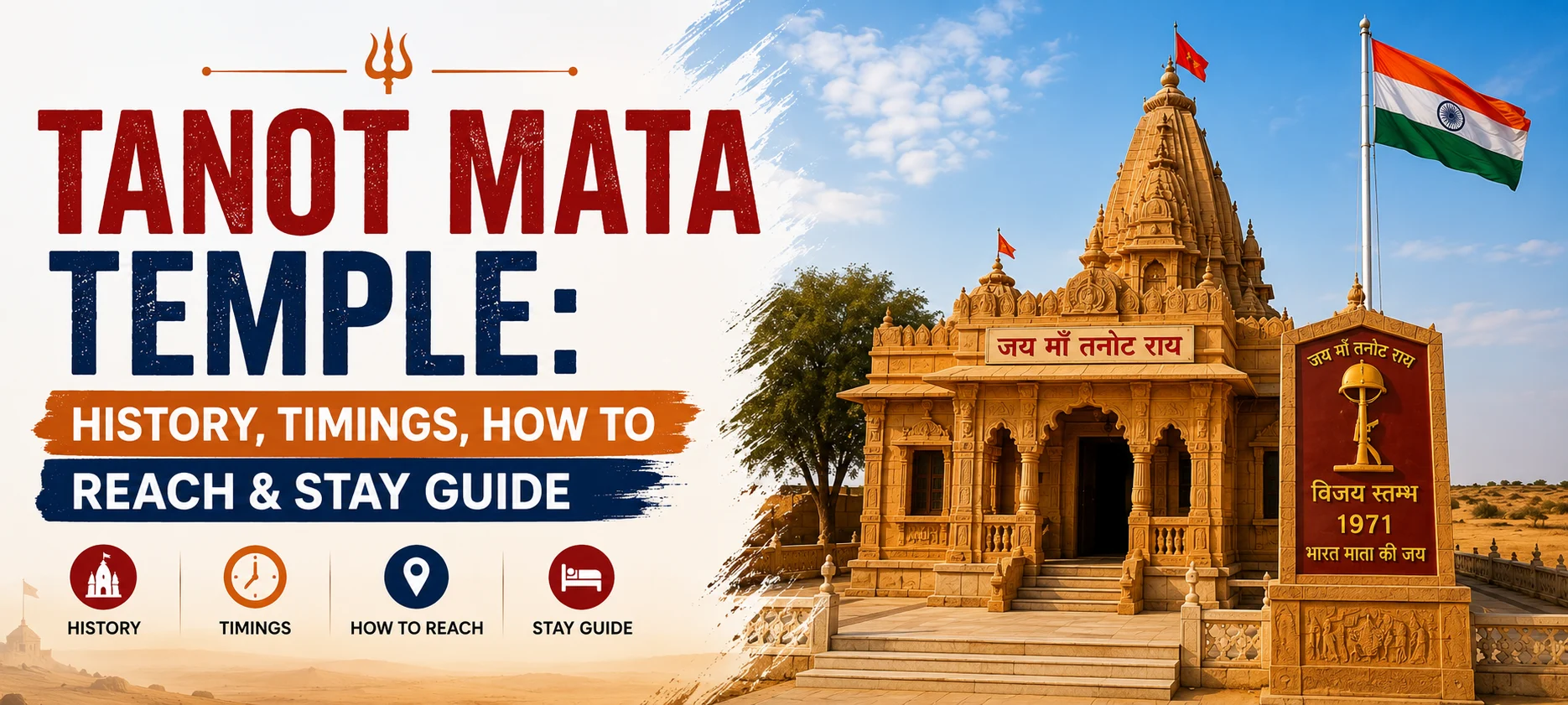
Tanot Mata Temple is a Hindu shrine in the heart of the Thar Desert, about 120 km from Jaisalmer and just 20 km from the India-Pakistan border. It is famous for one reason above all others: it survived heavy bombing during the 1965 and 1971 Indo-Pak wars without any damage - an event locals and soldiers still call a miracle.
Unlike any other temple in Rajasthan, this one is managed entirely by India's Border Security Force, not by priests. There are no traditional pujaris here - the daily aarti is performed by uniformed BSF personnel, a sight that most visitors describe as the most memorable part of the trip.
Because Tanot sits inside an active border zone, planning the visit correctly matters more than it does for a typical Jaisalmer attraction. This guide covers the temple's history, the war story that made it famous, timings, how to reach it, ID and permit rules, where to stay, and what to combine it with so your day trip is planned properly from the start.
Planning a Tanot Mata Temple trip from Jaisalmer? Call or WhatsApp Satnam Travels for a comfortable private cab with drivers who know the route.
Welcome to Satnam Travels
Quick Answer
If you want the short version before reading the full guide, here it is.
| Travel Information | Details |
|---|---|
| Distance from Jaisalmer | ~120 km (2–2.5 hours by road) |
| Distance from India-Pakistan Border | ~20 km |
| Managed By | Border Security Force (BSF) |
| Temple Timings | 5:00 AM – 8:00 PM, Daily |
| Entry Fee | Free |
| Permit Required | No (Valid original ID mandatory) |
| Accommodation Near Temple | None – stay in Jaisalmer city |
| Best Combined With | Longewala War Memorial |
Almost every visitor combines Tanot Mata with the Longewala War Memorial in the same day trip. Doing one without the other means missing half the story.
Key Facts at a Glance
| Category | Information |
|---|---|
| Deity | Tanot Mata, also called Aavad Mata |
| Built In | 828 AD, by Bhati Rajput ruler Tanu Rao |
| Location | Tanot village, Jaisalmer district, Rajasthan (PIN 345022) |
| Priests | None – puja and aarti performed by BSF personnel |
| Aarti Timing | Morning & Evening (main aarti 6:00 PM – 7:00 PM) |
| Food Facility | Small BSF-run canteen and shop on site |
| Festival | Navratri fair, held twice a year (April and Sept/Oct) |
| Best Time to Visit | November to February |
Who Is Tanot Mata?
Before the war story, it helps to know who the goddess actually is, since this gets confused a lot online. Tanot Mata is also known as Aavad Mata, believed to be the daughter of Mamadji Charan, a revered figure from the Charan community of Rajasthan. She is considered a regional incarnation of Goddess Hinglaj and, in some traditions, described as a predecessor to Karni Mata - the goddess of the famous rat temple in Deshnok, near Bikaner.
For centuries before the wars that made it internationally known, this was simply a Charan-community shrine, cared for by the Charan clan and worshipped by Bhati Rajput families in the region. It had no national profile. That changed permanently in 1965.
The History of the Temple
Historical accounts date the temple's construction to 828 AD, built by the Bhati Rajput king Tanu Rao, who installed the original idol. For over a thousand years afterward, it functioned as a regional pilgrimage site - respected locally, but not a place that appeared in national conversations about faith or history.
That began to shift with India's independence and the wars that followed with Pakistan, largely because of the temple's location. Tanot sits in one of the most exposed stretches of the western border, close to the desert route Pakistani forces used during both major conflicts with India. Its physical position, right at the edge of contested territory, is what pulled it into military history in the first place.
The War Story: What Actually Happened in 1965 and 1971
The 1965 War
During the Indo-Pakistani War of 1965, the Pakistani Army launched a heavy assault on the Tanot sector, firing an estimated 3,000 bombs and shells toward the area. Several hundred of these landed in and directly around the temple complex - some accounts put the number at around 450 shells within the temple premises alone. According to soldiers stationed there and the local population, not a single one of these exploded or caused structural damage. The sanctum, the idol, and the surrounding structure remained untouched while the desert around it bore the marks of the attack.
After the war ended, some of the unexploded shells were retained and placed on display inside the temple complex, where they can still be seen today.
The 1971 War and the Battle of Longewala
The temple faced a second test during the Indo-Pakistani War of 1971, the same conflict that included the Battle of Longewala fought a short distance away - later dramatized in the Bollywood film Border. During this war, Pakistani tanks advancing through the area got stuck in the soft desert sand near Tanot, giving the Indian Air Force a clear window to strike and destroy them before they could reach the temple or breach the sector further.
Following the 1971 victory, the Indian Army built a Vijay Stambha - a Victory Tower - inside the temple compound to permanently commemorate the win at Longewala. It stands there today alongside the temple, tying the site's religious identity to its military one.
After the 1965 war, the Border Security Force formally took over the temple's management and maintenance, a responsibility it still holds today. This is also why the temple has no priests in the traditional sense - daily prayers, aarti, and general upkeep are handled by BSF personnel posted there.
What to See at Tanot Mata Temple
A full visit takes around 45 minutes to an hour, and covers more ground than just the main shrine.
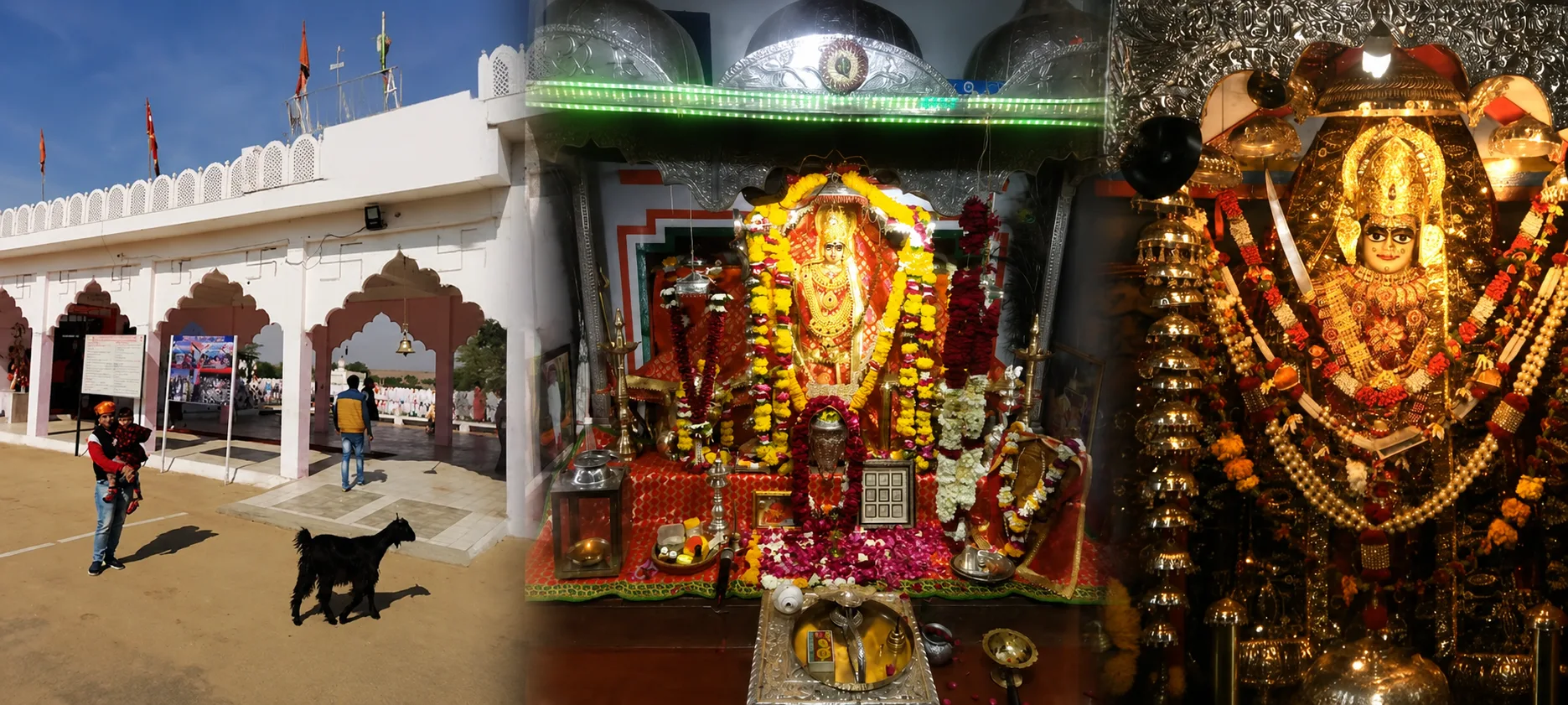
- The main sanctum, where the idol is dressed in traditional Rajasthani attire, surrounded by prayer flags, tridents, and offerings
- Twice-daily aarti performed by BSF soldiers, not priests
- Unexploded bombs and shells from the 1965 war, displayed inside the complex
- A small museum area with photographs and a projector screening the temple's war history
- Artillery pieces used during the conflict
- The Vijay Stambha (Victory Tower), commemorating the 1971 Longewala victory
- A scaled replica of the India-Pakistan border showing how BSF operates in this sector
- A small BSF-run canteen and shop, offering tea, snacks, and light refreshments
- Free prasad and chilled water, distributed by BSF personnel
Want to cover Tanot Mata Temple and Longewala without worrying about checkpoints, fuel stops, or return timing? Satnam Travels handles the full route.
How to Reach Tanot Mata Temple
By Road from Jaisalmer
This is the most common and practical route. The distance is around 120 km, taking 2 to 2.5 hours by taxi or private car. Public bus service is limited on this stretch, so a private vehicle or a pre-booked taxi is the reliable option. A sedan for a full day typically costs around ₹1,600–2,000, and an SUV somewhat more - worth confirming current rates before booking. The drive itself is part of the experience: sand dunes, windmills, and long open desert stretches the entire way.
By Rail
The nearest railway station is Jaisalmer Railway Station, about 120–123 km from the temple. Jaisalmer connects by regular trains to Delhi, Jaipur, and Jodhpur. From the station, you'll need to hire a cab for the onward journey - there's no direct rail link to Tanot.
By Air
The nearest airport is Jaisalmer Airport, connected to Delhi and Jaipur. From the airport, a taxi to the temple takes roughly 2.5 to 3 hours.
From Sam Sand Dunes
If you're staying at a desert camp near Sam, the distance to Tanot Mata is about 100 km, and several tour operators combine both experiences into one day.
What Are the Best Vehicle Options for Tanot Mata Temple

Private Cab
- Capacity: 6-7 Passengers
- Luggage: 3-4 Bags
- Features: AC, Comfortable Seats, Ample Legroom, Music System

Innova
- Capacity: 6-7 Passengers
- Luggage: 3-4 Bags
- Features: Reclining Seats, Powerful AC, Airbags, Touchscreen Display

SUV
- Capacity: 4-6 Passengers
- Luggage: 3-4 Bags
- Features: Leather Interiors, Cruise Control, Hill Assist, Powerful Drive

Tempo Traveller
- Capacity: 12-20 Passengers
- Luggage: Large Luggage Space
- Features: Push-back Seats, Powerful AC, Music System, Group Travel Friendly
.webp)
Force Urbania
- Capacity: 9-13 Passengers
- Luggage: Large Hold
- Features: Spacious Cabin, Powerful AC, Comfortable Seats, USB Charging, Safety Features

Self-Drive
- Capacity: 6-7 Passengers
- Luggage: 3-4 Bags
- Features: Daily and Multi-day Hire, Insurance Included, Valid Licence and ID Required
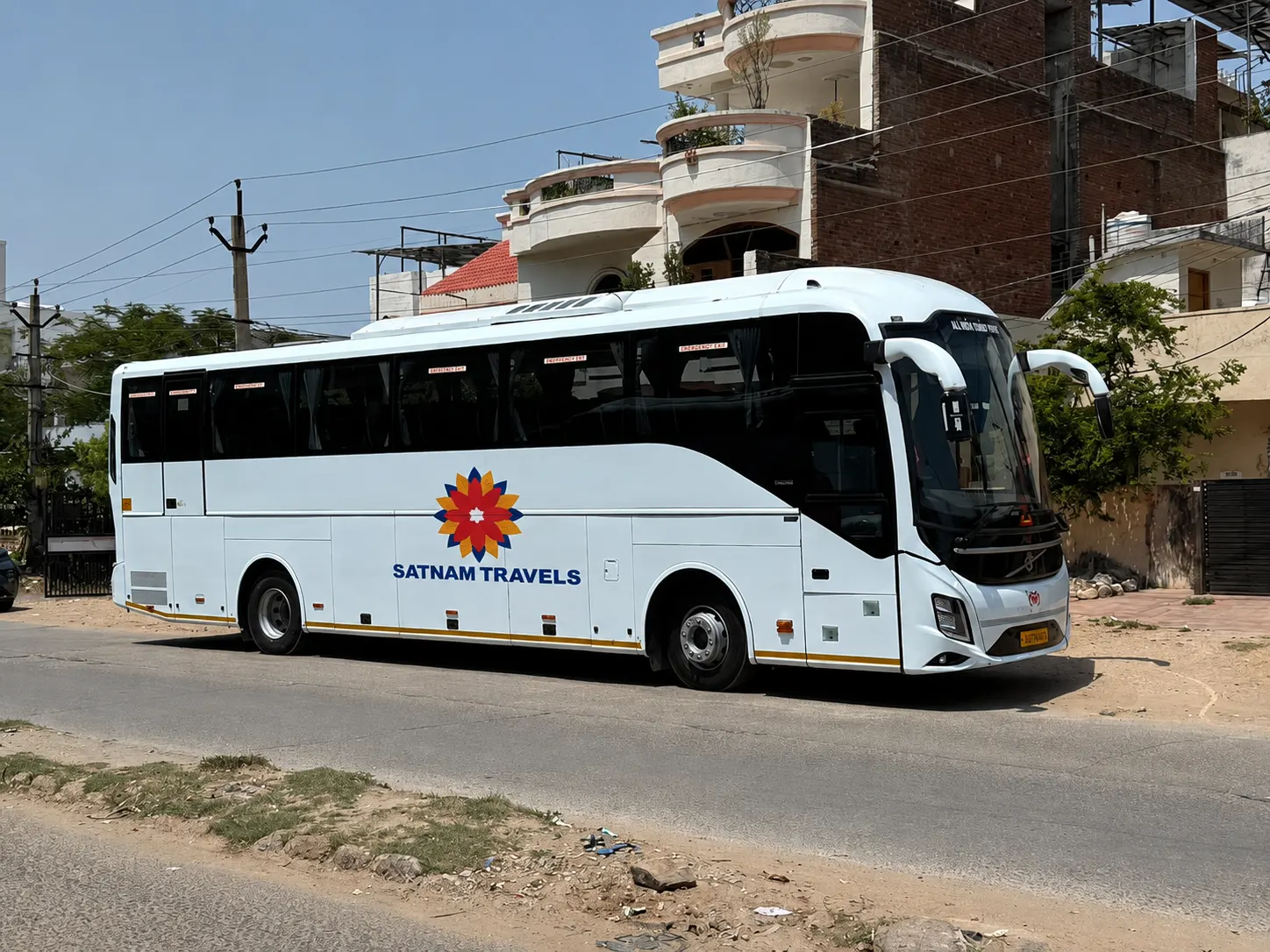
Volvo 9600
- Capacity: 45+ Passengers
- Luggage: Large Under-floor Luggage Hold
- Features: Push-back Seats, Powerful AC, Smooth Suspension, Music System

MG Glider Bus
- Capacity: 45+ Passengers
- Luggage: Large Luggage Hold
- Features: Premium Interiors, Powerful AC, Comfortable Seats, Long Route Ready
Best Time to Visit - Month by Month
November to February
The ideal window. Daytime temperatures are manageable for a long desert drive, and evenings are pleasant enough to catch the sunset aarti before heading back to Jaisalmer.
October and March
Reasonable shoulder months - warmer during the day, but still workable if you travel early morning.
April and May
Genuinely hot, with daytime temperatures climbing steadily. April is also one of the two Navratri fair months, so expect both heat and crowds if travelling then.
June
Peak summer, with temperatures regularly crossing 45°C. Facilities along the desert route are minimal, so this month is best avoided unless absolutely necessary.
Monsoon Months
Unpredictable weather on this desert stretch. Flooding isn't the concern it is elsewhere, but sudden weather shifts can affect visibility and road conditions.
Temple Timings, Aarti, and the Navratri Fair
| Details | Information |
|---|---|
| Temple Opening Hours | 5:00 AM – 8:00 PM (Open every day) |
| Evening Aarti Timing | 6:00 PM – 7:00 PM (Approx.) |
| Best Time to Attend | Arrive before the evening aarti to catch the desert sunset alongside it |
| Navratri Fair | Held twice a year - Chaitra Navratri (April) and Sharad Navratri (Sept–Oct) |
| Special Arrangements During Navratri | BSF organises a free langar; in some years, free medical camps too |
| Travel Tip | Expect larger crowds during Navratri - book Jaisalmer accommodation and transport in advance |
Do You Need a Permit? (And What ID to Carry)
No special permit is required to visit Tanot Mata Temple itself. Indian citizens, foreign nationals, and OCI holders can all visit without prior government permission. However, since the temple sits inside an active border security zone, carrying a valid, original government-issued ID - Aadhaar card or passport - at all times is mandatory. You will very likely be checked at BSF checkpoints along the route, and photocopies aren't a reliable substitute for the original document.
If you want to go beyond the temple toward the actual border fence - sometimes called "ground zero" by tour operators - that requires separate, prior permission from BSF headquarters in Jaisalmer. Your driver or a local tour operator can help with the application, but approval isn't guaranteed, so don't build your itinerary around it happening.
Where to Stay
This is a question a lot of first-time visitors get wrong: there is no hotel or resort accommodation at Tanot itself. The area around the temple is a restricted border zone, and the only formal option is a BSF Guest House, which requires prior permission and isn't a standard option for casual tourists.
In practice, everyone visiting Tanot Mata Temple stays in Jaisalmer city and does the trip as a long day excursion. Jaisalmer has accommodation across every budget range, from heritage havelis to full-service resorts, and it's realistically the only sensible base for this trip.
Food and Refreshments
Once you're past Ramgarh - the last town with regular shops on the route - options thin out considerably. The temple complex itself has a small BSF-run canteen and shop offering tea, snacks, and basic refreshments, along with free prasad and chilled water distributed to visitors. Beyond that, don't expect restaurants or dhabas along the desert stretch, so carry your own water and snacks for the road, especially if travelling with children or elderly family members.
Nearby Attractions Worth Combining
Longewala War Memorial
A short diversion off the main Tanot road - the actual site of the 1971 Battle of Longewala, with captured Pakistani tanks and Indian bunkers on display.
Jaisalmer War Museum
Located in Jaisalmer city, displaying vehicles and equipment captured during the 1965 and 1971 wars - useful context before or after visiting Tanot.
Kuldhara Abandoned Village
A 19th-century deserted village with a well-known local legend, located between Jaisalmer and the Tanot route.
Sam Sand Dunes
A popular desert-safari base roughly 100 km from Tanot, often combined into a two-day itinerary covering both the desert experience and the border temple.
Tanot Mata Temple vs. Other Jaisalmer Attractions
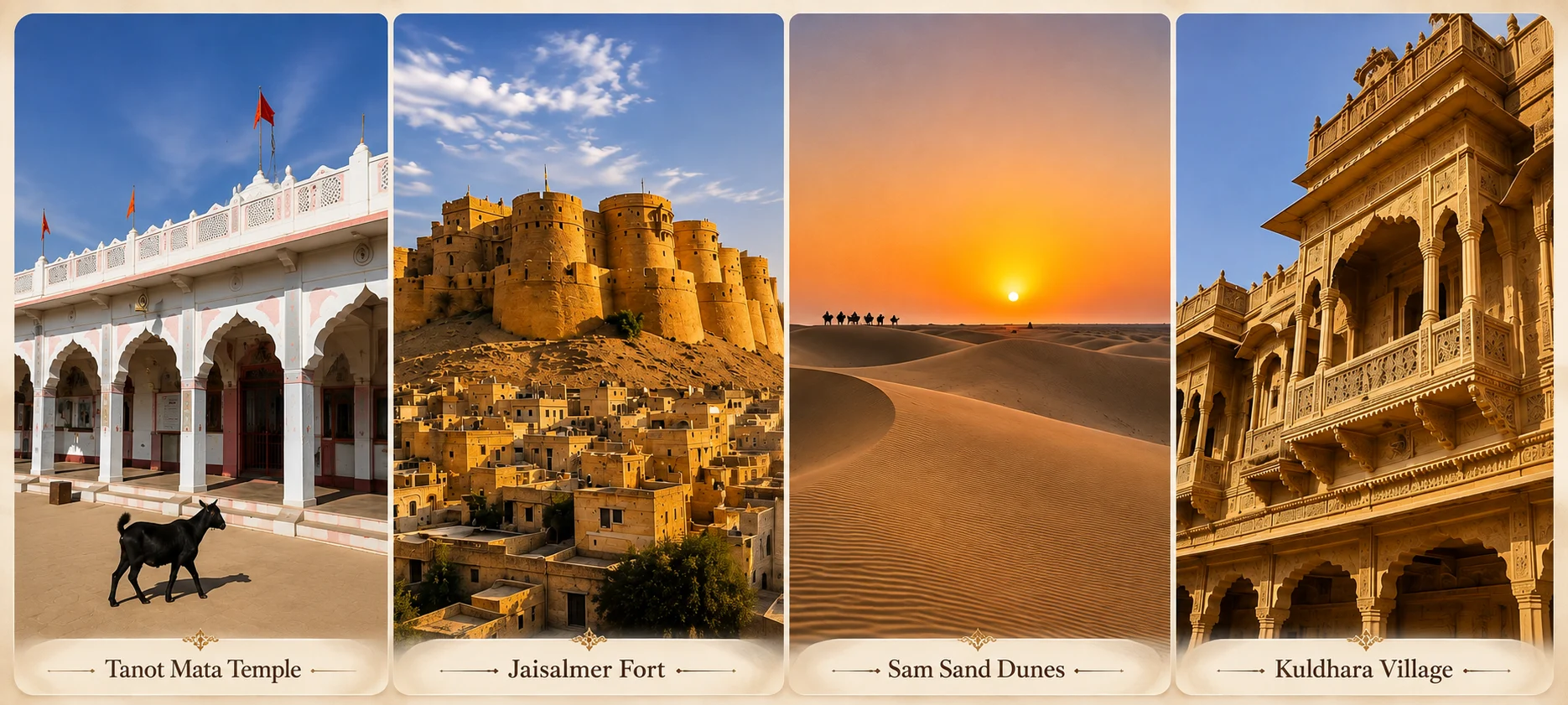
| Attraction | Time Needed | Best For | Distance from City |
|---|---|---|---|
| Jaisalmer Fort | 3–4 hours | Architecture, Jain temples | In city |
| Sam Sand Dunes | Half day / overnight | Desert safari, sunset | ~40 km |
| Tanot Mata Temple | Full day (with Longewala) | War history, spirituality | ~120 km |
| Kuldhara Village | 1–2 hours | Folklore, ghost-town history | ~18 km |
If you only have one day to spare, the Tanot Mata + Longewala route needs the most planning of any Jaisalmer trip - distance, ID checks, and limited facilities - but it's also the only one that combines active military history with a functioning pilgrimage site.
A Sample One-Day Itinerary from Jaisalmer
6:30 AM
Leave Jaisalmer by private taxi.
7:00 AM
Quick stop and breakfast, before the route thins out.
9:00 AM
Stop at Ramgarh for fuel, water, and last regular shops.
10:30 AM
Arrive at Longewala War Memorial, explore tanks and bunkers.
12:30 PM
Arrive at Tanot Mata Temple - darshan, museum, and Vijay Stambha.
1:30 PM
Lunch at the BSF canteen or packed food.
3:00 PM
Begin return journey to Jaisalmer.
5:30 PM
Back in Jaisalmer city with time to rest before evening.
This can flex depending on your pace, but the core structure - leave early, cover Longewala first, reach Tanot around midday, start the return by mid-afternoon - is what most experienced local drivers follow, mainly to avoid the desert road after dark.
Expert Tips for Visiting
- Start early (6:30–7:30 AM) from Jaisalmer to avoid rushing the return drive on remote roads after dark
- Carry original ID documents, not photocopies - BSF checkpoints are routine on this route
- Keep cash handy; digital payments are unreliable once you're past Ramgarh due to weak mobile network
- Pack more water and snacks than you expect to need - facilities are minimal beyond Ramgarh
- Dress modestly, and avoid photographing soldiers or security installations without clearing it first
- If visiting in winter, carry a light jacket for the evening - desert nights cool down fast
- If travelling during Navratri (April or Sept–Oct), book your Jaisalmer stay well in advance due to crowd size
- Fix your return timing before you leave; night driving on this stretch isn't advisable even for experienced drivers
Plan Your Tanot Mata Temple Trip with Satnam Travels
Experienced drivers who know the Jaisalmer–Tanot–Longewala route, reliable private cabs, and flexible timing so your border-area day trip is planned properly from the start.
Why Choose Satnam Travels?
- Experienced drivers who know the Jaisalmer–Tanot–Longewala route and its important stops
- Reliable private cabs for a comfortable, hassle-free day trip from Jaisalmer
- Route planning that covers Tanot Mata Temple and Longewala War Memorial on the same day
- Comfortable travel in a clean vehicle with enough space for your group
- Flexible trip timing based on your sightseeing schedule and temple visit
- Local route knowledge to help plan fuel, food, water, and suitable stops
- A safe and convenient journey without the stress of arranging transport yourself
- Vehicles suitable for families and groups of different sizes
- Easy advance booking so your transportation is ready for the day
Final Thoughts
Tanot Mata Temple isn't a quick add-on to a city sightseeing day - it needs a dedicated day, a reliable vehicle, and a driver who knows the checkpoints, the fuel stops, and the timing to combine it properly with Longewala without a rushed return after dark.
If you prefer a hassle-free journey with comfortable vehicles and experienced drivers, Satnam Travels arranges Jaisalmer border-area trips covering Tanot Mata Temple and Longewala War Memorial, so the logistics are handled and you can focus on the visit itself.
Frequently Asked Questions
It survived being bombed during the 1965 and 1971 Indo-Pak wars without sustaining damage - an event widely regarded as miraculous and central to its identity as both a religious and military heritage site today.
About 120 km, taking roughly 2 to 2.5 hours by road.
No permit is needed for the temple itself. Valid original ID is mandatory, and going beyond the temple toward the border fence needs separate BSF permission.
Daily from 5:00 AM to 8:00 PM, with the main aarti between 6:00 PM and 7:00 PM.
November to February, when temperatures are cooler and manageable for the desert drive. Avoid June, when temperatures can cross 45°C.
Yes, there's no restriction on the temple visit itself for foreign nationals or OCI holders, though original identification is still required at checkpoints.
No hotel accommodation exists at Tanot itself. The only option is a BSF Guest House with prior permission, which isn't practical for most tourists. Everyone stays in Jaisalmer city and visits as a day trip.
There are no traditional priests here - BSF personnel stationed at the temple perform the daily puja and aarti themselves, a practice unique to this shrine.
No, entry is completely free.
Yes, and almost everyone does exactly this. Longewala is a short diversion off the main Tanot road, and combining both keeps the full-day trip worthwhile given the distance involved.
Connect With Our Fleet Expert Representative will help you.
Welcome to Satnam Travels